Saro Montaperto’s discovery of the diamond necklace
The Shape of WaterSaro Montaperto’s discovery of the diamond necklace turns an exhausting day of garbage work into a private moral and financial crisis. A conspicuously valuable jewel appears at the edge of a factory site, where Saro takes it before he has decided what to do; the find then brings his family’s need, his wife’s insistence on honesty, and the attention of a man associated with Gegè Gullotta into the same chain of events.
The discovery
After emptying his cart a dozen times into a garbage bin installed where the factory’s rear exit had been, Saro approaches the path running beside the enclosure wall toward the provincial road. In the glare of a punishingly hot day, something on the ground catches the light. He bends down and sees a large heart-shaped pendant set with small diamonds around a much larger central stone. Its solid-gold chain remains attached, but is broken at one point.
Saro’s right hand moves before he has thought through the find: it grabs the necklace and stuffs it into his pocket. He stands, drenched in sweat, and looks around. There is no one in sight. The moment is both material and moral: the jewel is no longer merely an object on the ground, but a fortune that Saro has already concealed, even though its owner and circumstances of loss are unknown to him.
Need and honesty
That night, Saro and Tana recognize that this is not the kind of treasure found in old tales. The necklace is modern, and they are certain it was lost the previous day. They wonder whether anyone will report it missing, while the size of its likely value makes the possibility of keeping it difficult to dismiss. Saro wants to take it to the Siracusa brothers’ jewellery shop as soon as it reopens; Tana objects that honest people cannot simply sell something that is not theirs.
Saro’s reluctance to hand the necklace to the factory foreman is shaped by his distrust of Pecorilla. He fears the foreman would sell it himself rather than return it to an owner who came looking. His suspicion does not resolve the question of what an honest finder should do; instead, it narrows the choices available to a household with little money and no confidence that the property would be safely handled by someone else.
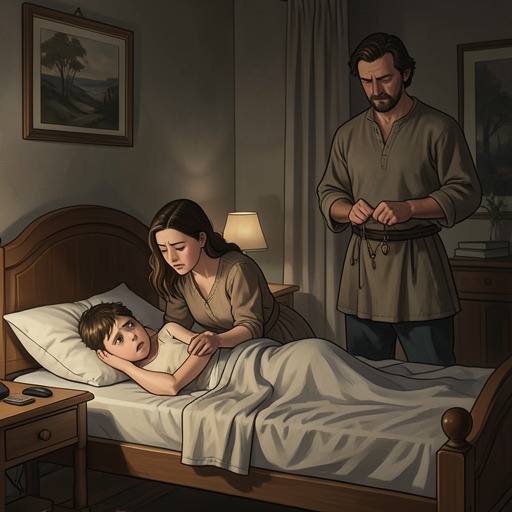
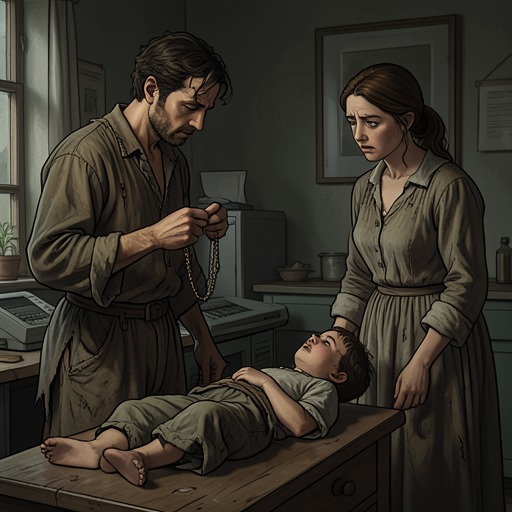
The discovery also falls against the distress of their son Nenè’s illness. The baby sleeps only intermittently, does not cry, and has a condition whose cause and cure the doctors of Vigàta cannot determine. His parents have been told they would need to take him to a specialist elsewhere, but they cannot afford it. Saro estimates that the necklace could be worth twenty million lire and immediately turns that estimate into the prospect of a two-million-lire finder’s share, asking how they could pay for Nenè’s treatment with such money. The jewel’s value is therefore measured not only in luxury, but in the care their child might receive.
A temporary bargain
Tana and Saro argue through the night. Their compromise is deliberately provisional: they will keep the necklace without telling anyone, wait a week, and pawn it only if nobody comes forward. This arrangement lets them describe their immediate decision as compatible with honesty, but it also makes silence part of the plan. The week is a test of whether an owner will appear and a period in which the possibility of converting the necklace into medical money remains open.
When Saro is washed and ready to leave for work, he goes to kiss Nenè and finds him sleeping deeply and peacefully. The timing lends the discovery an almost consoling meaning for Saro, as though the child somehow knows his father has found a possible way to help him. Yet the relief is temporary and uncertain: the necklace has not been sold, the owner has not been identified, and Nenè’s illness remains unexplained.
The necklace resurfaces
When Inspector Montalbano later asks where the necklace is, Saro steps forward despite his difficulty remaining on his feet. He opens the bedside-table drawer and takes out a packet wrapped in newspaper, which he throws onto the bed. Montalbano carries it into the kitchen and unwraps it. His appraisal holds two qualities together: the jewel is vulgar in design and conception, yet fine in workmanship and in the cut of its diamonds.
Montalbano asks when Saro found it, whether he told anyone, and whether anyone has come looking for a necklace like it. Saro says he told only his wife, then discloses that Filippo di Cosmo has visited. Di Cosmo is one of Gegè Gullotta’s men. The exchange changes the necklace’s status once more: it is no longer only a family’s hidden hope or a disputed claim to found property, but an object that has attracted attention from someone linked to Gullotta. The evidence establishes the visit and Saro’s disclosure, without establishing what Di Cosmo wanted or what would happen to the necklace next.
Narrative significance
The necklace connects private hardship to the wider pressures surrounding its disappearance. Its brilliance first catches Saro’s eye amid labor and heat; at home, its imagined price becomes inseparable from Nenè’s unaffordable treatment; later, its presence in a newspaper-wrapped packet makes it a fact Montalbano can examine and question. Each change in setting alters what the jewel means without changing the unresolved questions of ownership and danger.
The discovery also rests on a tension between a stated rule and the practical choices available to the finders. Saro invokes a percentage for people who find lost property, while Tana insists that the necklace is not theirs to sell. Their week-long plan postpones rather than settles that conflict. By the time Montalbano learns of the visit from one of Gullotta’s men, the couple’s attempted private compromise has been drawn into an investigation, and the object’s value has made it impossible to keep the decision merely domestic.